


Back
2025 Prestige Cotes de Provence Rose, Minuty
 Add to Wishlist
Acquired by the Farnet family in 1936, Minuty was one of 23 estates to be granted cru classé status in Provence in 1955. It continued to garner acclaim throughout the second half of the century, notably in the 1990s under the third generati on before, the year after the fourth generation took over in 2022, the estate was sold to LVMH. By Provençal standards, this is a very large estate, comprising 65 hectares of vines in a single block on the St Tropez peninsula, along with a further 120 hectares in inland Vidauban and 15 hectares in Ramatuelle. It makes both estate wines, under the Château Minuty label, and branded wines, incorporating bought-in fruit, under the simple ‘Minuty’ label – as seen here with a blend of 70% Grenache, 15% Syrah, 10% Rolle and 5% Cinsault. The wine is a blend of free run and direct pressed juice, aged in tank prior to bottling.
Tasting notes
Straightforward aromas from white-fleshed fruit to exotic fruit. The palate is complex, saline and fresh.
At a glance
producer
sub-region
region
country
grape variety
vintage
colour
abv
maturity
Not available
organic status

Provence
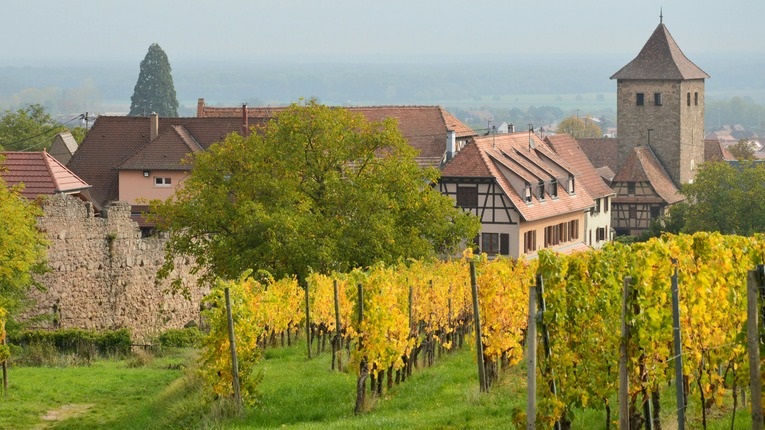
Sitting along the Mediterranean coast of France, bordered by the Rhône river to the west and the Côte d’Azur on the east, Provence is perhaps the world capital of rosé. It is also France’s original wine region. Founded by Phoceans in the 6th century BC when they brought vines to plant throughout the South of France. From the get-go, the wines produced in Provence were pale in colour due to the quick pressing and processing that the Phoceans favoured. When the Romans took control in the 2nd century BC, the pale wines of South France were already famous and highly coveted. During the 5th – 12th centuries grape-growing boomed and the local abbeys produced wine and sold it creating modern-day winemaking in Provence. This is when the aristocrats and grand officers in the royal army bought swathes of vineyard area. Unfortunately (particularly for the aristocrats), a less celebrated character can’t be overlooked in France’s wine history – Phylloxera. Following other regions, Provence suffered from phylloxera in the 1880s destroying almost all the vineyards, however, thanks to grafting techniques vineyards were replanted. Roll on the 20th century and a more competitive global market prompted winemakers to unite creating the co-operative movement so familiar to us. These producers then went about the task of setting out boundaries for various AOC regions within the area, successfully identifying 9 AOCs within the Provence region. Although we tend to think of Provence as one homogenous region, there is a great variety of geology and climates. The Mediterranean moderates the temperatures and the famous Mistral, a predominantly cold and dry wind blowing from the North, keeps the vineyards dry, free of pests and the skies clear. Côtes de Provence is the largest AOC, and the most prolific producer accounting for 75% of wine production (of which 89% is Rosé), within which there are four key sub-regions: Sainte-Victoire, La Londe, Fréjus and Pierrefeu. Coteaux d’Aix en Provence, Coteaux Varois en Provence and Les Baux de Provence also showcase the variety of the region, with Cassis, Bandol, Palette, Bellet and Pierrevert rounding out the AOCs. There’s a common theme to Provence, it’s just that little bit more complicated than it first appears, and it’s no different when it comes to the varieties used across the region. There are approximately 36 different varieties used originating from France, Spain, Italy, Greece and Hungary. To make matters that little more complex, each appellation has a different set of regulations regarding approved varieties. For reds, Grenache, Carignan, Cinsault and Mourvèdre are key, with Ugni Blanc, Rolle (Vermentino), Bourboulenc, Clairette, Marsanne and Roussanne common for whites. There are, however, smatterings of other local and international varieties too.
![2025 Clos Mireille Cotes de Provence Rose, Domaines Ott (75 cl) - Bottle [131302220250600750]](https://du5d0xxkq463h.cloudfront.net/media/catalog/product/cache/e748d881e54f2c9368fad2d1a1421cc2/1/3/1313022.jpg)
![2025 Cuvee Clarendon Cotes de Provence Rose, Domaine Gavoty (75 cl) - Bottle [143547820250600750]](https://du5d0xxkq463h.cloudfront.net/media/catalog/product/cache/e748d881e54f2c9368fad2d1a1421cc2/1/4/1435478new2.jpg)
![2024 G de Galoupet Rose, Cotes de Provence (75 cl) - Bottle [307304120240600750]](https://du5d0xxkq463h.cloudfront.net/media/catalog/product/cache/e748d881e54f2c9368fad2d1a1421cc2/g/a/Galoupet_G_packshot_without_background.jpg)
![2022 La Cigale Rose, Domaine Gavoty (75 cl) - Bottle [238377020220600750]](https://du5d0xxkq463h.cloudfront.net/media/catalog/product/cache/e748d881e54f2c9368fad2d1a1421cc2/2/3/2383770.jpg)
![2023 L'Excellence Cotes de Provence Rose, Chateau Les Muraires (75 cl) - Bottle [143936220230600750]](https://du5d0xxkq463h.cloudfront.net/media/catalog/product/cache/e748d881e54f2c9368fad2d1a1421cc2/1/4/1439362new.jpg)