


Back
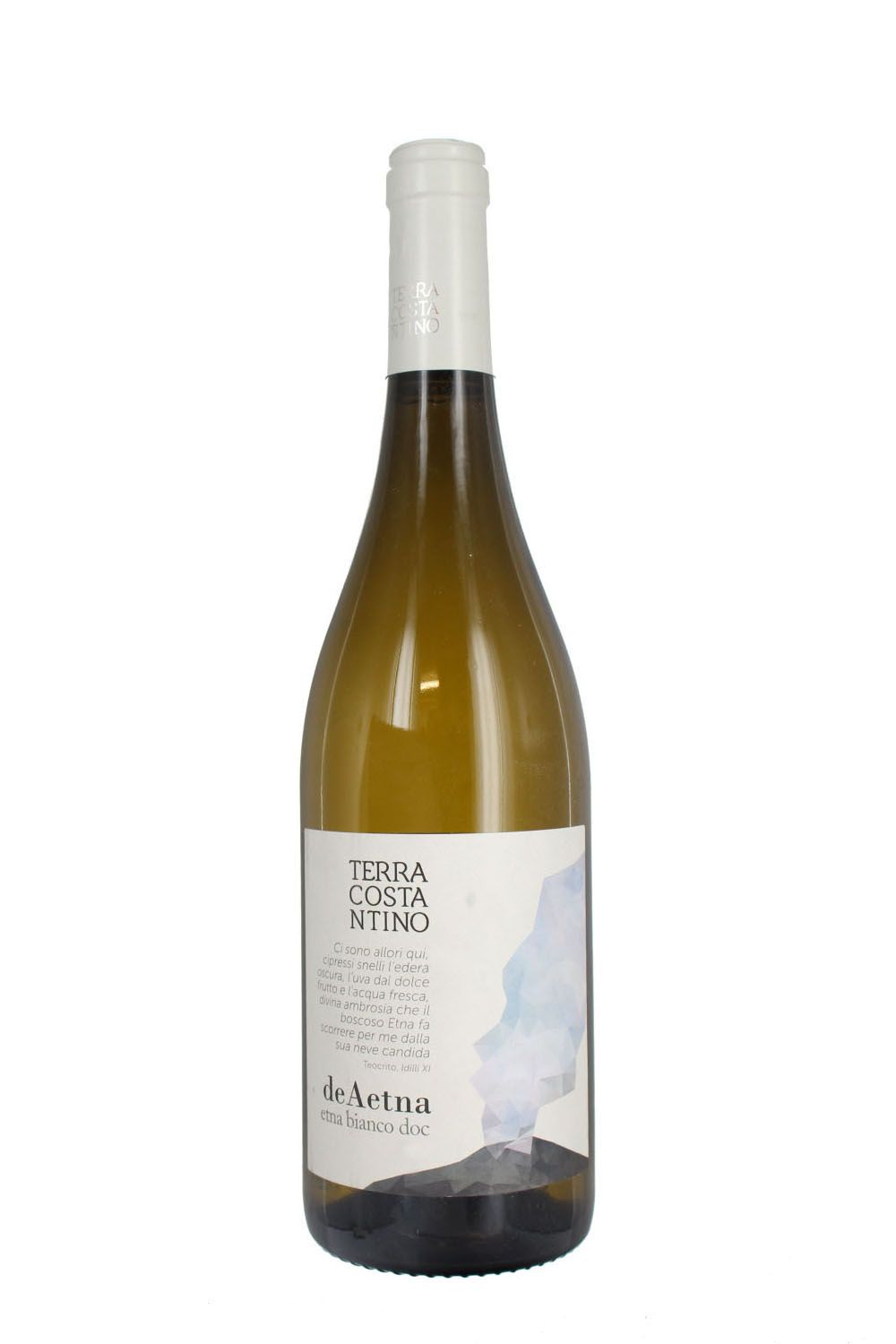
2023 Etna Bianco, de Aetna, Terra Costantino
 Add to Wishlist
Tasting notes
The nose shows mineral notes, bruised apple and a whiff on wood smoke. The palate has richness and depth, but also taut structure and full acidity, making a wine of great poise and elegance.
At a glance
producer
sub-region
Not available
region
country
grape variety
vintage
colour
abv
maturity
organic status

Reviews
The 2023 Etna Bianco deAetna lifts from the glass with a cascade of wildflowers, crushed rocks and lime zest. This displays soft textures while coming across as juicy yet refined, with mineral-laced orchard fruits and spices swirling throug hout. Crisp yet long, the 2023 finishes with poise.
Eric Guido
Sicily
Sicily, the Mediterranean’s largest island, often feels little to do with mainland Italy. Evidence of different cultures is visible throughout, with Greek temples, Roman villas, Byzantine remains, not to mention the influences of Norman and Spanish rule. Its position and size has made it strategically important over the ages and the legacy of this is a wide range of native wine varieties. Few regions have changed as much as Sicily over the past 30 years, with EU subsidies providing incentives to move away from low-quality bulk wine production and instead concentrate on high-quality, artisan production. Only now are export markets well and truly seeing the benefits of this, as the world becomes aware of the superb quality and character of Sicily’s wines. Whilst as a general rule the island has hot summers and mild winters, its mountainous nature means there are huge variations depending on the altitude of vineyards. In the main, rainfall is low and the dry southernly winds make ideal conditions for organic viticulture. There are 23 DOC’s in Sicily that cover defined geographic areas, plus the catch all DOC Sicilia which covers the entire island. The island also has one DOCG: Cerasulo di Vittoria DOCG. Most of the DOCs are not seen widely and have, at least for now, little value, with many producers choosing to ignore them in favour of using the more recognisable Sicilia name. It is also debatable how many of them have their own unique character and how many are political constructs. Most major international varieties are grown on the island, but its strength lies in a handful of indigenous varieties. Nero d’Avola possesses dark cherry fruit character and requires warmth to fully ripen its tannins, and even maintains good acidity. Nerello Mascalese is the signature of Etna and as it has become more fashionable, is now being planted throughout the island with varying degrees of success. A late ripener, it produces wines of relatively pale colour and good acidity that have a sour cherry character, mingled with herbal and tobacco notes. Like Pinot Noir, it has a fine ability to translate differences in terroir and with some age it has many of the characteristics of mature Burgundy or Barolo. Nerello Cappucino, Perricone and Frappatto are other important red grape varieties. Carricante is potentially world class white variety which was once widespread on Sicily but is now mostly confined to the slopes of Etna, thriving in the poor soils at altitudes of up to 1,500 meters. It is capable of producing high yields, but when these are controlled it has a minerality and intensity to match any variety. This structure is married with honeyed notes and white peach fruit, green apples and, with age in bottle, a kerosene-like note similar to aged Riesling. Grillo, through to be the best grape for making Marsala, Catarratto and Inzolio are other prominent white grape varieties. Etna is the most exciting sub-region of Sicily and one that has started to capture headlines around the wine world (and investment from outside the region). Vineyards are densely planted and surround 3 sides of the mountain at altitudes of 400m to over 1000m and the land is highly parcelated. There are 21 communes (with just one, Milo entitled to make Etna Bianco Superiore) which are in turn subdivided into 133 contradas – this is wine geek heaven. Most producers are fairly small and average quality is high. 60% of production is red, 30% white and the remainder rosato and spumante. The best whites tend to come from the southern and eastern slopes, the most perfumed and dramatic reds from the north. This highly active volcano is sometimes a dangerous place to make wine, but it is currently one of the most exciting fine wine regions in the world.
![2025 deAetna Etna Rosato, Terra Costantino (75 cl) - Bottle [179088920250600750]](https://du5d0xxkq463h.cloudfront.net/media/catalog/product/cache/e748d881e54f2c9368fad2d1a1421cc2/1/7/1790889.jpg)
![2025 Tre Venti Nero d'Avola, Cantine Birgi (75 cl) - Bottle [310947420250600750]](https://du5d0xxkq463h.cloudfront.net/media/catalog/product/cache/e748d881e54f2c9368fad2d1a1421cc2/t/r/TreVentiNerod'Avola.jpg)
![2025 Tre Venti Frappato, Cantine Birgi (75 cl) - Bottle [310945820250600750]](https://du5d0xxkq463h.cloudfront.net/media/catalog/product/cache/e748d881e54f2c9368fad2d1a1421cc2/t/r/TreVentiFrappato.jpg)
![2021 Contrada Blandano Etna Bianco, Terra Costantino (75 cl) - Bottle [174562920210600750]](https://du5d0xxkq463h.cloudfront.net/media/catalog/product/cache/e748d881e54f2c9368fad2d1a1421cc2/1/7/174562920170600750.jpg)