


Spanish wine regions: An overview of Castilla y León
See our other articles...
Previous Article
A guide to the Burgundy wine classification system
Next Article
How to choose a wine from the Rhône Valley
Castilla y León, in northern Spain, is the largest administrative region in the country. A deep sense of history permeates the arid plains of Castilla y León: the greatest concentration of Spain's 2000 castles (castillos) is found in the region, hence its name. Once two separate kingdoms, Castile and León, were united by king Fernando I in 1037. Catholic monks introduced vines that same century, importing winemaking techniques and expertise from France. The wool trade primarily generated Castilla y León's wealth until the 1500s. However, viticulture declined in the mid-20th century as widespread poverty forced growers to abandon their livelihoods and relocate to the cities.
Yet the ochre plains of Castilla y León look very different today. Investment has revolutionised formerly neglected appellations and Spanish wine regions. As a result, the region now produces a wide variety of wine styles, ranging from the powerful reds of Ribera del Duero to the mineral-scented whites of Rueda.
Click on a link to jump to that section:
Geography and terroir
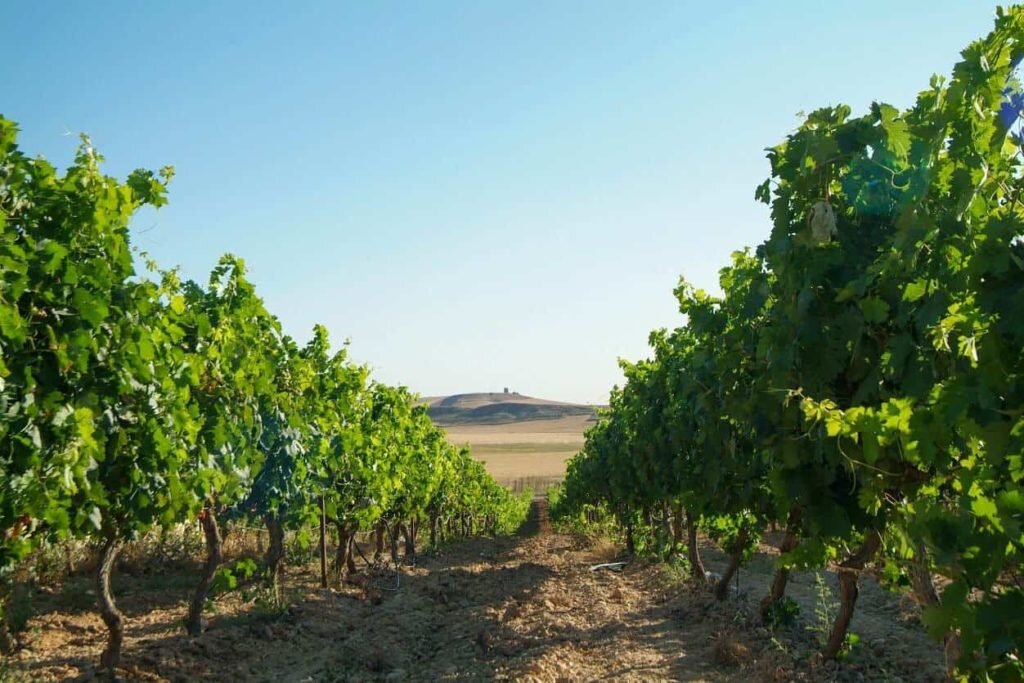
Covering the northern part of Spain's tableland, Castilla y León occupies a vast geographical area to the northwest of Madrid. Castilla y León's vast area borders Galicia and Portugal to the left and the Basque country and La Rioja to the right. Castilla la Mancha and Madrid sit on the southern border. A great deal of Spain's central plateau, the Meseta, is covered with wheat fields. However, beyond this agricultural mainstay is a treasure trove of vineyards that produce exceptional quality Spanish wine. Significant variations in elevation, soil, and aspect make it impossible to pigeonhole the growing conditions in this corner of the Iberian Peninsula. Nevertheless, the area's most important wine regions - Ribera, Rueda and Toro – are all high-lying vineyards with extreme climates. They experience sweltering summer days combined with cool nights and cold winters. Rainfall is very scarce during the summer, with average precipitation in July dropping as low as 20mm. High-altitude wine regions, particularly in Ribera, benefit from diurnal temperature variation. The marked difference in temperature between day and night helps preserve the grapes' acidity.Key grape varieties grown in Castilla y León
- Tempranillo – the Tempranillo grape, also known as Tinto Fino/Tinto del Toro – produces the vast majority of red wine in Castilla y León. It reaches an apogee in Ribera del Duero and Toro.
- Verdejo - yields delightfully crisp and fruity white wine in Rueda – this white grape is a staple in Spain; it’s Castilla y León’s reflection of Sauvignon Blanc.
- Sauvignon Blanc - occasionally blended with Verdejo, Sauvignon Blanc can add perfume and freshness to the flagship whites of Rueda.
- Garnacha - generally used to make rosé, old vine Garnacha can yield seductively scented reds in the granite and slate vineyards of the Sierra de Gredos.
- Mencía – this grape variety is one of Spain's lightest, fruitiest, most aromatic red wines. It is the signature grape of El Bierzo, located close to the Galician border.
Castilla y León’s key wine regions and appellations
Ribera del Duero
Ribera has become Spain's most fashionable red wine region, with its aromatic, rich, fresh reds predominately made from Tempranillo. Situated to the northwest of Madrid, its vineyards carpet both sides of the River Duero, rising to almost 1000 metres above sea level in some places. This vast, high plateau has attracted many investors since the 1990s, eight years after receiving DO status – several producers in the Rioja wine region have established premises here. The area's diverse soils seduced them, limestone, sandy loam and clay are all found, in addition to the favourable elevation. Indeed, thanks to the appellation's famously cool nights, the wine of Ribera has lively acidity to offset the voluptuous concentration of ripe Tempranillo. Pingus, Vega Sicilia and Pesquera, three of Spain's most prestigious red wines, are all made here. However, there is plenty of excitement in the boutique cellars hidden from the spotlight of fame.Toro
Most of Castilla y León's most outstanding wines are produced in the landlocked Duero River valley. The Toro wine region is no exception: some high-profile investors predict that Toro DO is Spain's next big thing. In the 20th century, there were a handful of growers in the wine region making rustic and alcoholic Tempranillo reds. However, a surge of capital has transformed the wine region into a beacon of intense, concentrated wines that boast sophisticated tannins and good freshness. Like Ribera del Duero, the secret to success in Toro is altitude. Planted at elevations that reach 840 metres above sea level, growers utilise the cool nights to stop acidity levels from plummeting; soils are a mixture of sand and clay. Moreover, Toro has an abundance of old bush vines that deliver low yields and high quality. These are big, powerful reds that shine in the colder months.Rueda
This is the birthplace of modern Spanish white wine. For centuries, Rueda produced a style called 'Dorado de Rueda,' a dry liqueur wine aged in an oak barrel for at least two years. Yet by the mid-1900s, the area had fallen into massive decline. However, Rioja bodega Marques de Riscal arrived in the 1970s, determined to reinvent the zone as a critical producer of aromatic whites. Investing in vineyards and changing methods of wine production, Riscal brought Rueda back to life. Verdejo is the key grape of the appellation, used to make a refreshing and unoaked style that has become popular across much of Europe and the US. Imbued with a distinct saline quality, Verdejo holds its acidity well, even in the torrid climate of Castilla y León. It is occasionally blended with Sauvignon Blanc and/or treated to maturation in barrel.